
A week later, dawn broke over a shivering Chiba City. To a degree, regularity and certainty brought comfort. The sun, for instance, always rose in the east—not due east, mind, that only happened at the equinoxes, but sayings never cared for specifics.
Most popular aphorisms are half-forgotten anyway.
By his measurement, the sun that morning was off by an angle of around twenty-two degrees. Rinkaku Harigane had rolled up his bedroom window (which actually faced due east—he had made triply sure), swung his legs out into the chill and slouched on the sill.
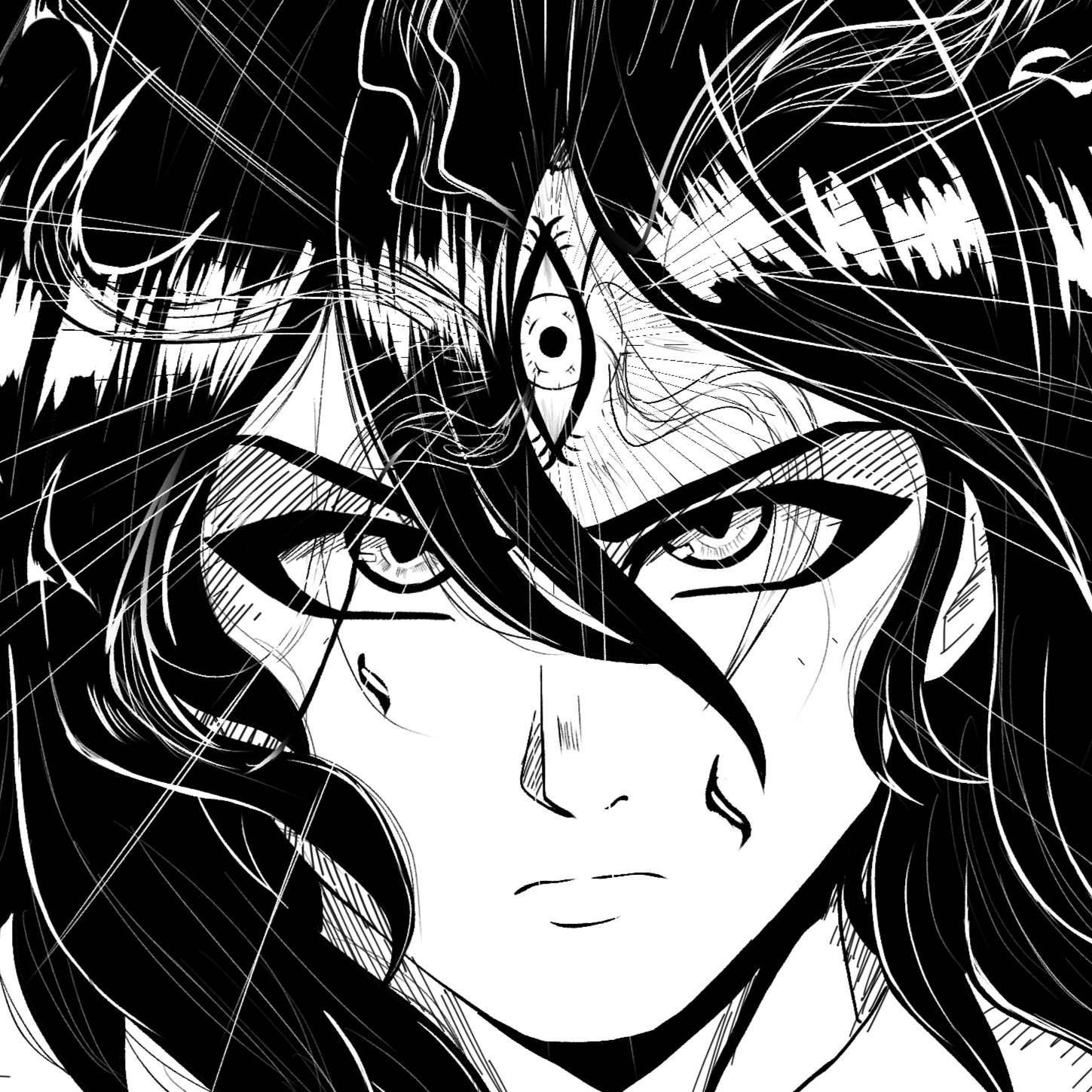
The boy was short, languid and lanky, a decent build—genetics, mostly. Folds and shadows underscored tired, scornful eyes. His attractive face wouldn’t have been so wasted on him had he given the slightest damn. Thick black hair, tousled in restlessness, bunched around his shoulders.
Rin squinted at the sun and stretched out an arm, contorted fingers into a rough set-square and ran through a routine of mental trigonometry. The sky was blissfully clear. Refreshing, for a change. It had been so grey for so long.
This hadn’t been in the forecast, though.
Why such sudden change?
His appraisal of the azimuth was a technique he’d developed to spite an astrophysics grad student seven years his senior who thought he could flex his oh-so-prized skill at astrometry. The look on the man’s face on losing to a highschooler was priceless. Rin didn’t have the remotest interest in astronomy. However, when it came to suspiciously specific and irrelevant dick-measuring competitions where someone else’s intellectual pride is on the line, he always won.
The sun had woken late that day. As had he.
They both shared the same attitude to winter mornings. Languid, slow, vaguely resentful: the pale winter sun peaked offset beyond the horizon and traipsed through the frosty morning. It had burned bright in his windows, past curtains he hadn’t remembered to close and phased directly through heavy eyelids, a rude awakening from his inextricably less-than-two-hours of sleep.
Thick, layered blueprints of the latest ill-advised, poorly designed and aesthetically horrendous megacity—drafted by the latest desperate oilfield nation in the middle east—shrouded him in place of a duvet. Similar papers lay strewed across his room, a carpet of annotated snow. His laptop heaved under the weight of the usual seventeen million idle browser tabs. Practically all printed designs had been defaced with the angry red scrawl of a lunatic.
How anyone with a functional pair of eyes, brain cell or substitute hamster wheel thought building a vertical line across a desert without any regard for basic infrastructure was a good idea was entirely beyond him. The concept would’ve made his blood boil if it weren’t so hilarious. Irrespective, he’d have to continue his study and subsequent ridicule some other time. School awaited.
Another familiarity, another certainty.
Joyous day.
One hasty mouthful of the leftover egg-fried rice later, he bid everyone else in the house farewell with a silent, disappointed sweep of the empty suburban homestead.
Why did he expect anyone else to still be here?
Malicious mail awaited beyond the door, and he nearly tripped. Rin sighed and stooped to thumb through the letters. Any for his father, he shredded and tossed over his shoulder with a mirthful spark.
The last was for him: a formal invitation for the National Mathematics Championship. Rin’s lip curled, and he shredded that too. He’d turn up and win, regardless of their invitation, thank you very much.
The parcel that almost caught his foot was hefty. The elaborately patterned tape sealing it shut was faded, a simple decorative measure. His name and address had been scrawled messily with permanent marker, beside a sticker from the—he squinted—Japanese embassy in Cairo?
What was this supposed to mean?
It was a shame, really. Egypt had some sensational monuments, and such a rich architectural history. Anything associated with that place, however, was tarred with an unfortunately bitter sentiment.
Rin’s eye twitched. After all this time, all his old man had to show for himself was a souvenir?
Then again, it was hefty. He shook the box, and a couple items—two, he intuited—thudded against the cardboard, cushioned slightly by some packing peanuts, or similar. Any word from his father was unhelpful at best. Brevity was the soul of wit; unfortunately, Katsuro Harigane was about as funny as a wet sock. He had anticipated some kind of postcard, a rambling letter about his latest “great discovery” which read about as smoothly as his academic papers (Rin had cross-referenced to make sure—the language was laughably identical.)
Never would he have expected a parcel.
His stomach curled on itself, a kind of innocent anticipation. A vile, hopeful curiosity welled in his throat. Rin grimaced. Seemed some of that pathetic childish sentiment still remained. He’d have to beat that out of his subconscious later: self-administered cognitive behavioural therapy or iron bar, whichever worked. Then again, his eyes were drawn once more to the box.
He wanted—no, needed—to open it.
A buzz from his phone told him indirectly to get a move on. The nerve. Rin sighed and threw the parcel into his satchel. He didn’t much care about being late for homeroom, but he couldn’t be bothered to deal with the scene it caused. Better to get a move on.
The street he lived on was a fair walk from the train station. It had been a pain at first, but pain dulled itself out over time. Everything did. The scuffing of his toes on the pavement before every step served a purpose: the friction chafed up the ice, less of a chance to slip. Someone a few paces ahead did exactly that not half a minute later. Rin sighed and offered a hand. The embarrassed salaryman took a moment to recognise the gesture, long enough for Rin to shrug his shoulders and retract it. His loss.
Both hands buried deep in pockets, bag swinging from shoulders, he cut down a side-street overlooking a park nearby—a nifty shortcut that put him in front of most early morning commuters walking to his station. Approaching a bench, and a small rectangular item hit the ground a few feet in front. His eyes twitched at the motion, but he elected to ignore it.
“Young man? Oh, young man! If you could—”
An aged voice somehow managed to interrupt his ceaseless train of thought. Rin spun on a heel. The gentleman wore a faded black duster, and mirrored, oval sunglasses. Thick dark hair thin lined with grey extended in a pair of sideburns. A walking stick trembled on the ground, grasped for dear life by hands that were losing their grip, day by day. Rin did a double take, eyes narrowed. The curvature of the nose and cheekbones was disturbingly familiar. The old man had the Harigane face, like a grandfather he’d never known—but that was impossible.
“I accidentally dropped my wallet as I was trying to take out some money,” the man rambled, chuckling. “Would you mind picking it up for me? These old joints aren’t what they used to be.”
Rin ogled the old man for a good few seconds. He didn’t like the way the corners of his mouth curled into a pair of opposing C’s, as though watching a shitty daytime comedy show.
Normally, this wouldn’t bother him.
Maybe it was ire leftover from the package that nearly sent him sprawling over the porch, but Rin’s patience had worn as thin as his impromptu bedsheets that night.
“You dropped that deliberately. I saw you. You’re not slick,” he said, voice flat. Bending down to retrieve the wallet, he exaggerated the effort with a comical groan, his back stiff. “What is this, some test of my character? Do you enjoy being a nuisance, old man? Do your folks not visit enough? Filling the loneliness with pity tricks on strangers is stooping pretty low.”
The old man chuckled. “Hand it back, son. That’s quite rude.”
“You know what?” Rin interjected, scratching the back of his head. “If you had just, you know, asked for some company, I might have indulged you.”
Not a shred of a lie: he only cared about getting to school on-time to save himself the bother of having to tune out another lecture on his conduct.
“Instead, you resorted to this. Elders deserve respect by setting good examples for the youth. What kind of example are you setting by trying to dupe your way into some shorthand pity from a stranger, gramps? Wise up, or keel over already.”
He tossed the wallet into a storm drain and walked off.
“Oh dear,” the old man muttered, gaze fixed on Rin’s retreating back. He didn’t sound the least bit offended. The comment came from a place of amusement, maybe tinged with a little pity. “You’ve done a terrible thing, haven’t you?”
Rin was too far out of earshot to hear, let alone care.
“Shibaru’s grandson, truly a chip off the old block.” Old Man Consequences shook his head, and the observant crow gave its haunting caw. The wallet floating in the drain vanished. He removed his sunglasses, revealing eyes glowing eerily white. “Misfortune accumulates like a cloud—the sum of deeds, checks and balances. Luck is but a flow, but fate is absolute. If you don’t change your path, Rinkaku Harigane, your fate won’t be a pleasant one.”
Rin should’ve seen the warning signs when the discarded mirror on the street smashed under his heel. Not so. He’d never been superstitious. Religion and belief in the supernatural was just misguided interpretation—a stopgap for the masses’ lack of understanding and, when organised, proved an effective method of indoctrination and control.
That was all.
Nothing he could bear to be concerned with.
All he could bear to think about was what was in that box. Rin had no time for silly ideas like ‘gathering misfortune.’ He had a train to catch.
The trainside platform already heaved with the to-and-fro of morning commuters. Students in their uniforms, stood alongside the workforce in their own. A faceless crowd, a standard for conformity, replicated at metro stations nationwide.
Rin suppressed a yawn with the back of one hand, looking down at his watch. No doubt about it, he’d definitely be late for homeroom. A shame, but nothing he hadn’t managed to shrug off before. In any case, the distraction that had delayed him wasn’t his fault.
A hand tapped him on the shoulder, and he jumped.
“Not awake yet, sleepyhead?”
The familiar voice shattered his morning daze. Rin turned to see a girl, similar height, facing him with a smile.
Dressed in the same uniform, hers was a lot tidier and more stylised than Rin’s. She had tailored them herself, little frills along the collars and sleeves of her shirt. Her blond hair was out of place among the sea of black, but was natural: tidy, and furnished with two long silver knitting needle-like hairpins.
Rin, by contrast, looked like he had been dragged backwards through a hedge. To an outsider, it would be difficult to see any reason why she’d be reaching out to him at all.
“Good morning!” She bowed as much as the bustling crowd would allow.
Rin graced her with wary side-eye. His face showed nothing beyond the existential fatigue that comes from an unhealthy relationship with one’s bed.
“Amibari,” he acknowledged flatly, a simple nod. He didn’t look at her for long, returning to study the miscellaneous advertising plastered across the subway walls, ever trying to find the words of the prophets amid the noise.
Kinuka Amibari realised a response wasn’t coming. Her giggle was unconscious, dragged from her lungs to fill negative space. “Busy this morning, isn’t it?”
“It’s rush hour…”
“Oh, right you are…” She fiddled with a ring on her finger, deflating slightly. “Well, how are you?”
“Vaguely inarticulate.”
She laughed. He didn’t even look at her.
“Are you alright, Rin? It’s been getting colder lately…”
“Only matter of time before the energy company realises I can’t pay the bill. They haven’t cut the power yet.”
He was joking.
She hoped.
“Do you have a good coat?”
“Somewhere.”
If he did, he wasn’t wearing it. Then again, he didn’t look cold. Rinkaku Harigane never looked much of anything except tired. He did once. The thought of it made her throat tighten.
“I’ve just finished up some new thermal shirts,” Kinuka continued. “I had some new material delivered from a new wholesaler. They’re really high-quality.” She beamed. “It did take a while to tailor them to the uniform standards once I got them made, though. Did you realise they updated the standard over last year?”
“Take a good look at me and ask yourself whether I pay attention to nuances in the dress code.”
She gave him a once over and felt rather silly. The question had been rhetorical, but still.
“I hate the mass-produced brands,” she continued. More negative space to fill. “They’re all so cheaply made, and those composites—they shed so much plastic, really irritates my skin. You can’t wash them, or else they fall apart.”
“Mhm…”
“Mine should last a while, though. I think. I hope so, anyway. I could give you a few, if you like?”
“They won’t fit me.”
“I remember your measurements, silly!”
He side-eyed her again. “That’s really creepy…”
“Oh—” Kinuka winced. Her grip tightened on her other hand, both held fast to her chest. “I just thought that…”
He arched a brow.
“… Never mind.”
He shrugged and pulled out his phone. Thirty seconds of scrolling elapsed, before—
“Rin, look at me a sec—” She tilted her head, pursing her lips. “Your face is so pale…”
“Yeah, just another part of my natural glow…”
“Are you getting enough sleep, Rin? You look tired.” She raised a hand and cupped his jaw, tracing the contour with a finger. His eyes widened immediately, branding her with fear and reproach. She retracted, stung.
“Sorry, I—”
She reached for him again, but Rin batted her hand away. A weight brushed against her palm. Her fingers instinctively closed around it.
“Enough.”
The train pulled into view with a deafening rattle. Rin turned on a heel.
“Just give it a rest.” More words attempted to escape him but jammed in his throat. He fought them, hard, swallowed, and shook his head. “Forget it. I have nothing left to say to you, Amibari.”
The next she knew, Rinkaku Harigane had already disappeared among the sea of the faceless. She stood alone on the platform, her empty hand stretched out towards him, perhaps in the hope that he would look back.
He didn’t. Not once.
For anyone else, today would be a special day. Eighteenth birthdays were usually the subject of coming-of-age movies, weren’t they? Kinuka wasn’t asking for a film crew, or even a huge party, but waking up alone to an empty house meant the smile took a little longer to stick in the mirror that day.
She had almost resorted to sewing pins.
Now, adrift in the swell of the crowd, she was even more alone. The commuters didn’t spare her even a passing glance, save for ogling her unusual hair.
The automated announcer made her final call. In imminent danger of missing the train, she took off down the platform at a run.
She hoped he would’ve remembered from all those years ago, if not recently.
These last few weeks, she had really been trying. What had she done wrong? She had hoped for a look in her direction; some nice wishes, perhaps; a smile, even. Then, she might remember what it was like to smile.
Was that really too much to ask?
Did he even remember?
Throwing herself into the first open carriage, Kinuka fought the black-suited bodies and buried herself in a standing corner. She scoured hot, misty eyes with the cold backs of her hands, smearing her eyeliner into a cloud across her upper eyes. Like a windshield in a rainstorm, nothing she did could stop the thin film of tears. She screwed them tight shut, just as she balled her hands. But one fist wouldn’t close fully. Opening it, a small black box tumbled into her palms. How long had she been holding onto this? She forced herself to look. Even as the train surged and screamed through the endless dark, she summoned the dexterity to still her fingers and prise it open.
She stifled her cry with the back of one black-stained hand, a singular silent sob sent a convulsion through her chest. The surrounding passengers cast their ambivalent judgement.
The velvet interior clutched a pair of earrings: skeletal silver cubes, dangling from a short chain. The sight of them didn’t last long, before the blurry veil descended and began to drip down her cheeks.
Of course he remembered.
Tear-stained, the bright metal glistened in the sterile overhead glare. The fabric would absorb the rest.
Kinuka swallowed hard and clenched her jaw, sealing her lips lest any sound escape. She closed the box in both hands and held it fast to her chest, curling inward around it. Even with her eyes screwed tight shut, but nothing could stop the tears from ruining her foundation.
For all intents and purposes, a school building should inspire its students. Was that not the purest purpose of education? To enlighten, to enthral, to cultivate the minds of the next generation to do and be the best that they themselves can offer, both for their own sake and others’.
Architecture was far more than just brick-and-mortar. The layout, the holistic ethos that goes into pattern, placement and spacing is quintessential: what isn’t there is just as important as what is.
Senketsu Chiba Prefectural High School should have been a bastion of aspiration. Goodness knows the regional government could find the money to make it so if they gave a damn.
Rin could already see it: four slender towers standing bright and pure in the winter sun, stalwart around a central atrium open to the sky. Striated wooden panelling separating each floor, with each classroom conducive to self-reflection and open to communication. Crisscrossing networks of intuitive walkways between making entrance and traversal accessible. The light would be everywhere, and it would be natural.
But the ideal and the real would always juxtapose, however, and that fact irritated him.
The reality of this accursed institution hit one on the head like concrete, and good lord was there a lot of concrete. Rin leant back in his chair, eyes tracing the ceiling’s regular grid of fluorescent lighting. The bulbs, perpetually years beyond needing replacement, hummed and flicked like android insects trapped in painful, cylindrical isolation cells.
Whenever his supposed educators said something interesting, he sat up and listened. To that end, he had spent most of the school day asleep, stirring only briefly when passed his recent set of practice exams.
He was already going to college. The numbers—all high nineties—failed to mean much anymore.
His classroom was like any other, so regular and repeated. No distinction was permitted, no beauty to be found in its orthodox confines. The beige on the walls washed out to the point it mirrored the utter indifference of its captive body of students. No wonder the country faced such a shortage of hope among its youth. The seldom joy they could find in a society that barred self-expression was isolating and frowned upon, because of course it was. Every time he gazed out at the world beyond the glass, Rin wouldn’t have been surprised to find iron bars.
That was another thing about regularity and certainty. It might have comforted some, but it bored Rinkaku Harigane to tears.
It was the architecture of defeat.
Whoever was responsible for this travesty had given up years before they’d even started.
He pitied them.
He imagined the poor sod rotting away at some desk, wiling away their sacred time, fulfilling responsibilities with no more effort expended than was expected: a good little citizen.
There were just so many of those.
Functional, suffocating, the building stifled any creative thought, buried any spark of ambition beneath mountains of exams, clinical highways of acceptable career paths, behavioural counselling, and a harsh ironing out of anything remotely remarkable.
Rin shut his eyes—not, he hoped, out of cowardice—to avoid letting the sight beguile him any longer. The shades of grey failed to emulate any nuance. The ethos was black and white, so infantile he could cry.
A headache thudded against the back of his skull. Probably dehydration, or a merciful aneurysm.
It wasn’t for lack of funding. Senketsu was top-rated academically. His record might’ve played a significant part in that—who was he to say?
The buildings themselves were relics of post-war Japan’s utilitarian streak—cold, grey monoliths that served their purpose without ever asking if they should aspire to more. The school had undergone a few cosmetic touch-ups in decades following, but beneath the occasional coat of fresh paint, the same depressing skeleton of steel and stone sucked the life and joy out of youth. Rin’s fingers drummed against his desk. Oh, what Senketsu High could have been, if the architects had bothered to care.
Worse still, somehow, no-one else seemed to notice, much less care. His classmates were indistinct, good little students, and shuffled in and out of class like sleepwalkers, ambitions as threadbare as the linoleum underfoot. The place mirrored its inhabitants—both unremarkable, both content to exist without bothering to wonder what lay beyond.
What would the world look like in four dimensions?
He had to know.
Unfurling his notebook, pages thick and matted not with love but sheer neuroticism and weight of ink, he clicked open a pen and brushed stray locks of hair behind one ear. Schläfli had first conceptualised the polychoron in the 19th century: a polyhedron made of polyhedra, a hidden axis beyond human comprehension. Rin felt a spiritual connection to his memory, and the pioneers of theoretical hyperspace that followed. He would continue their lineage.
Just as a three-dimensional man would appear godly to beings in a two-dimensional world, such would be true in further increments. If only he could ascend to the fourth dimension. For now, he could only conceptualise. He had turned tesseracts, cubes within cubes, into hyperstructures. On the next full-page spread, he had systematically detailed a house that could seamlessly transition between several separate rooms simply by viewing from a different perspective on the fourth axis.
This had the potential to revolutionise the very concept of living spaces. If only anyone else could see that.
That was the root of the issue. Very few bothered to look beyond the third dimension.
Others had done in the past, the point where mathematics became so abstract facts became a matter of opinion—but their work was seldom known, much less understood.
He had been curious ever since he could remember. Why wasn’t everyone else?
A veritable world lurked just beyond the veil, and no-one even cared! That was their loss, he had decided. There was no use in preaching to the deaf.
Turning the page, he kept sketching. Rin focused in on the scratching of his pen, until all noise faded away until he was left with only the workings of his mind.
“Harigane.”
A voice, familiar enough—unfortunately—to rouse Rin’s consciousness from the depths of whatever doze-dimension it had drifted into.
“Oi, Harigane!”
Rin thought maybe, if he pretended he had gone deaf—or died—the annoyance would give up and leave—or die.
“Harigane! Wake up, damn you!”
A ruler rapped him sharply on the back of the head.
Rin yelped and sprang upright. Peeling the paper currently glued to his cheek with drool, Rin noticed he had filled in another ten whole pages. A lot more time had passed than he’d been aware of. Everyone else chatting animatedly to their neighbour, or to another close by—class in remission. The yawning teenage abyss in his gut politely informed him it was more than likely lunchtime.
“What the hell was that for?” Rin massaged the wound.
Unlike Rin, the newcomer stood properly and carried themselves well. He had cropped black hair with a coif and distinct parting shone under the clinical lighting. You’d need a comb and a ruler to get a parting that straight—how droll. The jacket to his uniform had a stiff, tall collar that hugged the edge of his shirt.
Perhaps he styled it like that in an attempt to look imposing.
Rin thought it made him look like a pencil.
“You again.” He made a noise halfway between a sigh and a groan, one that ended up sounding like neither. “What do you want now, Bingo?”
“Bango!” The correction came with a snarl. “Bango! How many times must I tell you? My name is Bango!”
“I don’t care.”
Smack!
“Ow! Fuck!”
“I’ll do it harder next time,” warned Dentaku Bango. “And fix your tie, Harigane. You look like a slob.”
Rin loosened it even further and stuck out his tongue. “You can piss off. I’m busy.” He picked up his pen, flicked to a fresh page and restarted his sketching.
“With what?” He cast a scathing glare down. “Oh. More deranged scrawling.
They’ll have you put in an asylum before long, you know.”
“So long as they don’t put you next door, anywhere would be better than here…”
“You’re not going to explain it to me? I thought you would’ve jumped at the chance.”
“Why would I? Trying to communicate any kind of vision to you is like explaining the United Nations to a jellyfish.” Rin yawned. “Come back to me when you’ve figured out what the Kobayashi–Hitchin correspondence is.”
“It relates the—”
“That wasn’t an invitation!” Rin dragged both hands down his cheek and exposing the whites of his eyes. “If I wanted someone to tell me what I already know, I’d be talking to the mirror!”
“Do you ever intend on paying anyone any respect at all?”
“Yeah, find me someone who deserves it. Oh, speaking of respect—” Rin dived down and fished an additional wad of papers from his bag. “I read your proof of the Ramanujan Conjecture—”
Bango’s surprise quickly gave way to a frown. “You stole it.”
“Stealing implies it’s worth a damn.” Rin rifled through the paper, revealing reams upon reams of angry red scrawl. “It’s dreadful. Did you get a toddler to write this? I went through at least ten ink cartridges before I was halfway through.”
“You critiqued it?”
Rin barked a laugh. “Hardly. I was about to tear my hair out after you messed up your Dirichlet series for the nth time; ended up designing a tensegrity skyscraper instead, see?”
Flicking to about halfway through, Rin opened the booklet and shoved it in Bango’s face. The impressive schematic was scrawled in scratchy red pen over the carefully derived formulae.
“I got bored after that.” Rin tore out the page and tossed the rest of the proof to the floor. Crumpling it into a ball, he tossed it at Bango, hitting the boy square in the forehead. “Want my autograph? That design will be worth millions. Thank me later.”
Resisting the urge to throttle him, Bango spied Rin’s test results. Revenge. He snatched them up and held them aloft. Rin screeched and grappled in vain. Bango grabbed the boy’s forehead and held him away at arm’s length. Rin clawed like a savage dog.
“One hundred percent?” Bango raised an eyebrow. “Not bad.”
“Not bad?” Rin slapped the hand from his face, his eye twitching. “What’s it to you?”
“So, you do care.”
“Jealous, Bongo? Scored another ninety-six this time?”
If Rin was any better at being this smug, he could list it on his resumé.
Bango looked seconds away from an aneurysm. “Of course not.” He tucked his own results further into his back pocket. “I came to check up on the state of my competition. I can’t afford to have you slip up before the real thing.”
“Not this again.” Rin pinched his nose. “You really think I’m competing with you? We’re not even playing the same game.”
Bango’s eyes narrowed. He slapped Rin’s results back down onto the table like a set of divorce papers. Stowing rubbished proof back into his briefcase, he turned away. “I trust you received the invite to the championships? You had better be there. I’ll show you up for good. I’ll tear that smirk from your face if it’s the last thing I do.”
Rin, having exhausted all other ways to demonstrate his exasperation, rolled his eyes and let his head fall onto his desk as though he were an ostrich burying it in sand.
“I—” He banged his forehead against his desk after every word— “do not care! Go away!” After that, he just lay there.
Bango clicked his teeth. Slinging his briefcase over his shoulder, he made swift exit. His fellow students baulked at the simmering rage and parted like the red sea, casting around wary glances.
A good few minutes later, Rin lifted his head off the desk to find a glorious absence of Dentaku Bango, as well as anyone else. He checked his watch. The lunch hour had begun.
The mathematics championships: of course Bingus chose that as his opportunity to rear that childish rivalry again—the only track on his broken record.
At this point, Rin doubted even a hobby could save him.
The boy laboriously lifted himself from the chair, retrieving satchel along with. The convenience store bento rumbled comfortingly inside its nebulous depths, along with that strange package.
All thoughts of Mango vanished immediately.
How unfortunate.
Rin vaulted over the desks on his way out, turning a swift left out the classroom door and making a beeline for the rooftop.
That disgusting wellspring of childish curiosity bubbled up in his throat. Time to see whether that dusty deadbeat had anything to say for himself after all.
 XCEL
XCEL 
Leave a comment