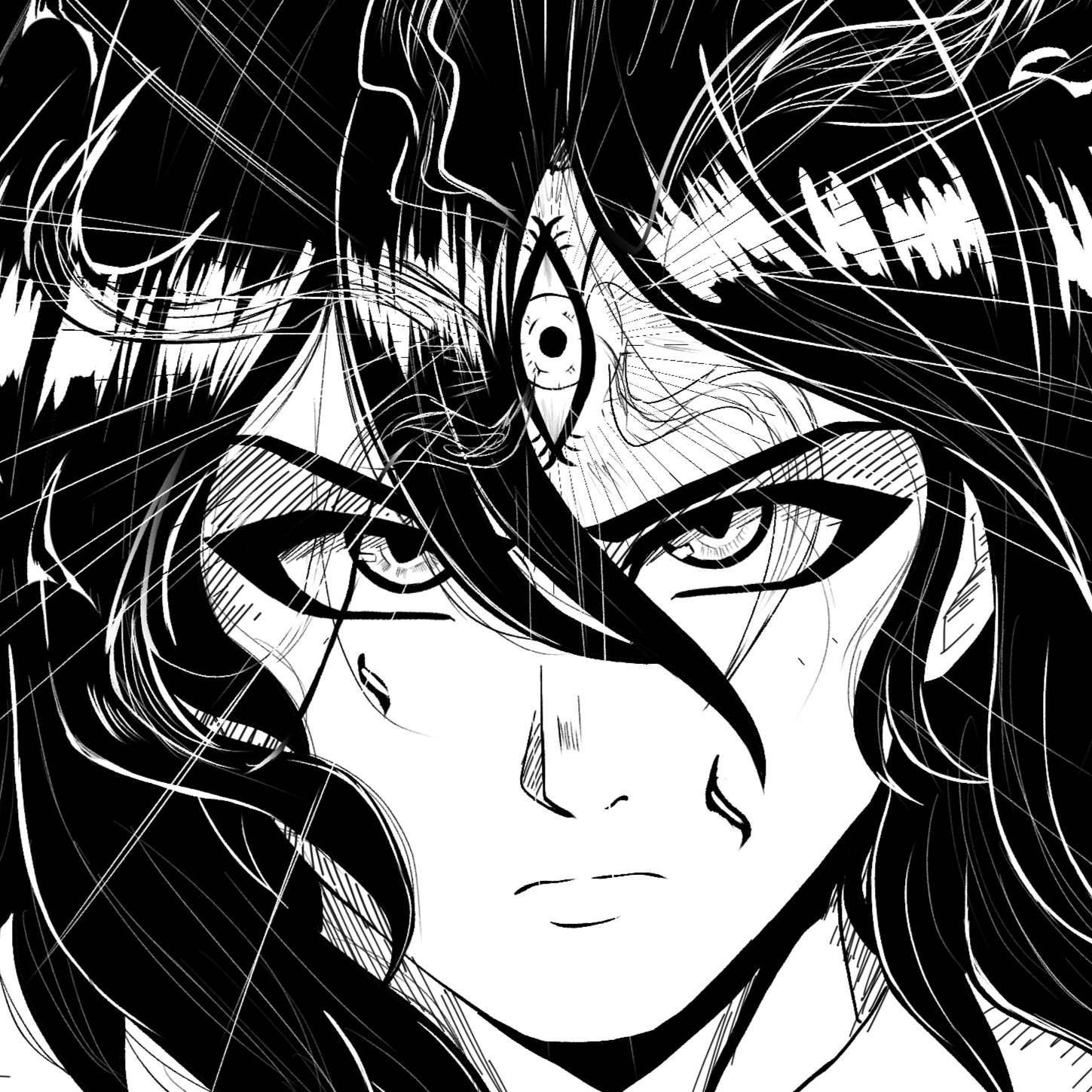

With neither hide nor hair of Rin sighted since she’d shot him screaming from the rooftop, it didn’t take long for Kinuka Amibari to grow bored. He had told her to stay put; for the most part, she had. She stared up at passing clouds, strolling in aimless circles on the concrete, before two key questions finally occurred.
What right did he have to tell her what to do? And, why was she even listening to him?
She didn’t have a watch on, and her phone had met the same fate as Rin’s. So, the best approximation she had of the time was guesswork. The cowardly sun hadn’t faced the day just yet.
They still had time, in other words.
Kinuka wanted to return on time out of courtesy to their new friend. Tegata was brave and kind as he was mysterious; above all, however, he seemed the nervous sort. She feared he might worry if they didn’t return, and needlessly compromise himself with ensuring their safety. The possibility of someone risking their life to save theirs a second time didn’t quite sit right with her. Things had very nearly gone sideways already, and Kinuka had to thank whatever deity that had allowed them to survive their run-in with that JPRO assassin.
She had never gotten her name.
It’s not usually something you’d think to do when fighting off an assassin. Then again, it had been her first time. What was her point of reference? Even so, ever since her awakening, Kinuka had experienced what could only be some supernatural empathy.
Earlier, when she and Rin had pushed through the crowds on the way here, she had picked up thousands of little signals from the buzz around their heads, a hum of latent psychic energy, charged with subtle emotions unspoken through the face or mouth. There were so many, with such minute detail, that she found herself overwhelmed. The strained look on Rin’s face suggested he had felt similar.
It made sense. These powers were new to them both. She would need time to accommodate the strain in her mind.
To focus on her mission, she had shut it all off. Later, when her life was on the line, her third eye had opened and her perception sharpened, and she began to pick up on those little signals again. With every collision, they showered her face like tiny, hot sparks, metal from a grindstone. Kinuka had felt a silent resentment, a jealousy. The sadness had ebbed off her like a wave, prickled with thorns of killing intent.
The reality check hit, and Kinuka asked herself why she felt sorry for a woman who had just tried to kill both of them. She seemed conscious enough to speak, to curse her for turning her back. Kinuka wasn’t so convinced. The girl’s eyes were dull; her face, completely blank. An external voice had spoken through her mouth. Kinuka couldn’t quite pin it down, but in her heart of hearts, she was convinced the girl’s actions had not been entirely her own.
Snapping her out of this dismal train of thought, her legs twinged with restlessness. To hell with waiting; to hell with what Rin had to say. She was going to go home by herself.
The police looked fairly preoccupied with whatever it was they were up to—smoking, trading playing cards, scowling menacingly at passersby—so, hopefully she could figure something out before they spotted her.
Descending the side of the building, the arm she’d unravelled into a bungee cord wound itself back into place at her side. She was getting better with practice. It was beginning to feel more natural now. A hop, skip, and several near-misses later, she made her way further down the street without being seen. Her house was on the opposite side of the street to her now.
While the riot squad were preoccupied with surrounding the Harigane house, she had ducked into a tight alleyway and hidden behind a stack of crates to give herself space to think.
The first thing she asked herself was what Rin would do. Why that? Fuck!
She couldn’t do that. She shouldn’t. Rin had a different ability—a different mind. Who knew what went through his head? Kinuka once thought she did. She bit her lip. That was naive thinking. She had never asked him what he thought. Up until now, he hadn’t stayed within talking distance for long enough to give her the chance.
It wasn’t her fault, right? That was just how it had been, these last three years.
Any thoughts she had projected into his head had been just that.
Rin would come up with some ludicrous sounding idea that would then work brilliantly, followed by him proclaiming once again to anyone that would listen that he was the best, no contention.
She couldn’t think like that.
What could she do?
She looked down at her hands. The fingers began to unravel themselves into threads without her realising. As though bored of waiting for her to figure it out, the sun peeked from behind its fluffy grey bedclothes and shot a beam off something shiny right into her eye. She looked up, only to see the telephone wire stretching out across the street, over the heads of all the officers, bunching up at the anchor positioned just to the right of her bedroom window.
That was it.
The core mechanic of her Threadwork came in two parts: whatever she unravelled, she had to put it back together again. Kinuka knew what her limbs should look like. So long as she kept the distinct picture in her mind, she could pull it off just fine. What she was about to attempt may well have been crazy, but she’d be damned if she didn’t try.
It started with her finger, then her hand, then her arm. The unravelling was painless, but still eerie to watch. She unravelled her body into a single woven string, which snaked along the floor then climbed the telephone pole metres away like a jungle creeper. The string coiled itself along the wire, without causing the slightest sway, and traversed the distance to her house in only a few minutes. The string was just an extension of herself, after all. Her third eye enhanced her proprioception such that she could feel where the end had reached, as though she were touching her toes with her eyes closed. The string snuck in through the crack in her window, fell off the windowsill, flopped onto her bed, and coiled into a heap.
Next came the difficult part. Kinuka willed the end of the string to start the reverse process. The threads split apart, and started to wind together back into their original shape. Her fingers started to reform, followed by her entire hand. Kinuka could feel the fabric of her bedsheets again, despite technically standing over thirty metres away!
Her triumph unconsciously accelerated the process. Kinuka stifled a yelp with her free hand as more of her body began to unravel at increasing speed. It was a surreal sight, seeing yourself disappear along a telephone cable in real time. She stumbled against the crates out of shock, as the tearing of fabric consumed the entirety of her right arm, her right leg, until the entire right side of her body was gone!
Consumed by a wave of dizziness, she sank down against the side of the building and resolved to trust in the process. Her right side was now reforming in her own bedroom. As the unravelling string began to tear up her face, Kinuka lent her head back against the brick, and closed her eyes. The shearing threads perforated her ears, tore apart her face, and disassembled her brain.
When she came to, Kinuka found herself (or, at least most of herself—there was still some left to come through the window) lying spread-eagled on her bed, as though this had all been a dream. She lay still and allowed her ability to run its course, until the last lashings of string slipped in through her window and whipped her in the face. The last strand embellished a red streak across her cheek. She yipped in pain and rolled around on the mattress, massaging the sore skin with her reformed left hand.
Pins and needles rolled in waves through her entirety. She shivered in place, individual muscles spasming. Kinuka didn’t dare move until everything came to rest. The fact she could still feel pain, however—the fact she could still feel the pads of her fingers on her cheeks—meant one thing.
Success.
That was what she could do.
She slid off her bed with an early-morning grogginess. It was strange and wrong to feel the carpet under the soles of her shoes. She bowed and apologised to a silent, empty room. Hers always looked and felt far smaller than it actually was. The Amibari Household was enough for three people, and little besides. Kinuka’s bedroom was not only where she slept and studied, but also the only place she had to practice her craft.
The interior practically resembled a living loom, a walk-in wardrobe so large it had spilled out and taken over the rest of the space. Outfits of her own design in their dozens, some more work-in-progress than others, hung neatly from rails and from improvised metal trees. Reams of fabric of all colours stretched from floor to ceiling, draped from rollers and pulleys suspended from crude hooks. She always had far too many projects at once. So many ideas, and no time or patience to follow any of them through. The income she made from selling her clothes went, first, to her college fund, and then into getting more material. It was no wonder she started projects faster than she could finish them.
Kinuka drifted under the curtains of material, pawing at the weaves in their bare, unfinished state. Her fingers traced down the sleeve of a light woollen coat. A present for a friend, a dear friend. Her elder brother had passed away at the beginning of the year from surgery complications. She hadn’t known the boy especially well, but one thing she remembered was a smile that shone like the sun. The jacket was triple-layered: thick and cosy, but not especially heavy; the kind you could swaddle up in on a frigid walk to the park, or through the winter forest. She hoped the familiar radiant detailing on the back would bring a smile to her face, rather than tears. The present was supposed to be for her birthday, back in August, but the organic wool had taken so long to arrive that Kinuka planned instead to finish it by Christmas.
All her designs, all her work. It had all taken so long, and she was so proud.
She didn’t expect to have to say goodbye so suddenly.
The threat of JPRO felt a million miles away now. She wanted to shut her blinds. She wanted to turn on her little lights, to roll herself in her blankets and shut the world out. That night in the loft had been so cold.
But she couldn’t run away.
Rin would never admit it, but she felt—she hoped—he was counting on her. Tegata, too. She had promised to help last night, after all.
But she didn’t want to leave this all behind.
Kinuka sighed and wiped away a tear. Her gaze fell—as it always did—to the gigantic tapestry loom that took up the entirety of the southern wall, her greatest work to date, and the one she might never finish.
“Daddy, what is this?” The blond child stared up in blind wonder at the colossal wooden frame that had been erected along her bedroom wall. A seamless canvas of white threads were stretched up its length.
Today was her eighth birthday, but she hadn’t been allowed in her room all day! That was okay. Mom had taken them all to the mall! She was with all her friends—even Rin came along. It had been so much fun, to the point her legs ached a little from all the walking.
Kiji Amibari wiped the sweat from his brow and notched his pencil back behind one ear. A small box of tools stood on the dresser. The man was covered in sawdust, but grinned from ear to ear. “Ever since you could walk, Kinuka darling, you wanted to help us in our business,” he said. Your mother and I felt guilty that we could never let you—the work we do, it’s too intense for you just yet, but it meant the world to us. We didn’t want to force you into anything, but since you seemed to love it so much—”
“We thought we’d give you a project of your own to work on.” Asaito Amibari finished her husband’s sentence. She always had a much less apologetic tone, a very clipped tongue. She rounded the stairs to the landing with a wrapped box in both hands. She crouched down and offered it with a smile.
Kinuka gasped with delight and took care to untie the ribbon and peel off the paper. The box presented her with reels of thread in a rainbow.
“That’s just to get you started,” Asaito said. “There should be enough colours in there, but let me know if you need more, okay?”
Kinuka withdrew a few colours and approached the loom. Her eyes sparkled. “You mean, this is—”
Mom was normally quite stern, which only made her smile that much brighter. “It’s your tapestry, dear. It can be whatever you want.”
“I love it!” Kinuka immediately started pacing back and forth in front of the loom, pressing the reels of thread to the white in an attempt to map out some colour. “This is amazing!” She tried to reach for some of the higher strands, but found herself coming short. Pouting, she reached once again before admitting, “I can’t reach…”
“That’s for when you grow up to be a big girl. This is a big project, and it will take you a long time. Start where you can reach, and when you grow up, you’ll be able to reach the whole canvas.” Asaito crossed the room and linked an arm around her husband’s waist. They shared a look, then a smile, and stayed that way for a time before Kiji crouched down beside the little girl.
“Can you promise something for us, darling?”
She nodded.
“We’d like you to work on it, just a little bit every day. Only do as much as you want, so long as you work on it. Even if you only tie one loop, that’s still progress. We’ll even help you, just to get you started. How does that sound?”
“Okay!” Kinuka beamed. “Can we start working on it right now? Can you help me?”
Mom and Dad couldn’t have looked more delighted. Sewing kits were extracted from drawers, and before the day was out, the first sprinkles of colour and design had lovingly peppered the loom. The laughter from that day was irreplaceable, unforgettable.
From that day on, Kinuka held her promise. Every single day, she added a little bit of colour to the loom. Some days saw more than others, but she made sure—even on her worst days—to make good on her word. The designs started bright and haphazard: shapes and patterns emerged and in a conflagration of fairly complementary colours, with some odd contrasts at times. She was just a kid, after all.
The years went by, and Kinuka began to perceive herself in the world for the first time. The subsequent layers became more reflective. Distinctive moods and the first flights of melancholy pieced themselves together over time. Sights and scenes seen through both her eyes and mind became immortalised through thread, as she worked her way through early adolescence.
Still, she added to it every single day.
There was anger in these threads, there was grief—but like the days themselves, there would always be happier times.
Several of her phases and fancies blended into one another in a seamless procession. The beloved cartoon mascot panda Bibimaru enjoyed his time in the limelight with his friends, before passing the baton to her first fictional crush from a magical girl show she was enamoured with as a child. Kinuka had painstakingly detailed her sparkling entourage in their eternal fight against the forces of darkness. It gave her hope.
Only her closest friends had the honour of adding to her wall. She had spent hours with them, teaching them how best to layer the threads. Even Rin had contributed in his own way. After a lot of fruitless convincing, he had obstinately waited for her back to turn before designing an impressive electric-blue skyscraper under a geometric starry sky, before denying all responsibility when she tried to congratulate him.
Some things never changed.
By the time she graduated from middle school, however, some things evidently had. The work became patchier in a place around the middle, along with a prominent strip of black. There were no stars in that sky. Some threads had been torn and replaced, but there was still a distinct absence. Kinuka threaded her finger through one of the gaps. Even now, she couldn’t find it in herself to fill it. It wouldn’t feel right.
As the days went by, Kinuka’s style evolved as she began to take her craft more seriously. The past remained untouched, but on-going patterns became more deliberate and recognisable. Conscious art was being created for a purpose. Kinuka had known she wanted to be a designer for as long as she could recall.
High school came with having to think more about one’s future. Any iconography became sparse to none, instead focusing on emulating patterns in nature. The oceans and seascape from their holiday in Okinawa transitioned to thick and hypnotic groves, all the way to the sprawling cityscapes. She had tried many times, but she could never get the buildings quite right. She didn’t have the eye for that. The walls always flowed. Nothing could ever stay still.
Landscapes from photographs, still with the reference material pinned nearby, took up large swathes, as the canvas began to fill up piece by deliberate piece. People went about their lives, arm in arm. Kinuka’s arms remained her own. Boys had tried their luck, but found her oblivious. Even when her friends had pointed out her options, she had just never been interested.
Mom and Dad still asked to contribute from time to time. Their schedules had grown increasingly busier with the blossoming of their independent business and its sales. Still, they took the time to helped her conceptualise the vision in more ambitious areas. She was grateful for their time.
Still, she worked on that tapestry every day—all until two days ago.
There was still a final piece missing: an area right at the top. Everything was built around it, that one missing piece. The landscapes and the figures within all pointed towards it, but Kinuka couldn’t see what they were pointing to. She had encountered blocks in the past, but had always seen the light one way or another. She had avoided even thinking about this area for the last month, choosing instead to fix other areas in need of just one more thread.
She couldn’t lie to herself anymore. She had been running from it all this time.
Ten years of work, and the tapestry might never be complete.
Had she squandered her only chance?
Would she ever fill that blank in?
What would it look like?
Kinuka stared at the canvas a little longer, and felt her lip tremble.
“Why can’t I see it?” Her voice warbled. “Mom… Dad… I don’t know anymore…”
Her voice had no echo. The shawls of fabric gave her the privacy she so desperately needed. She wanted their hands on her shoulders again. Her mother’s tight hug, her father’s hand-squeeze. Anything. The cruel draft from her window tickled the inch of bare skin between her socks and trouser hem instead. A tear and then several rolled down her cheeks.
Her parents weren’t here anymore.
She didn’t know when they would come back.
When they did return, would she still be here?
A week ago, they had left for the airport to America. Stood by the front door, she had asked, “Can’t I come with you?”
Mom and Dad, bags already in hand, had given her the best smiles they could. “This conference is a once in a lifetime opportunity, darling,” Mom had reminded her.
“It might take a few weeks, so we need someone to look after the house. You’re a big girl now. This is your opportunity to do teenager-y things without us getting in the way!” Dad’s coy wink never failed to get her eyes rolling, but he was serious when he needed to be. “We trust you, Kinuka. We’ve left you enough money for food and then some. Make your own mistakes. Choose your own path. We’ll always be here for you when you need us. Just give us a call, okay?”
In the present day, Kinuka reached for her phone—and her fingers failed to grasp. She sobbed quietly into empty hands. Reality started to fade in through the blinds, the shining of the midday sun. She couldn’t hide behind her shawls anymore. She had formed her resolve to find the truth. That resolve now hung over her head, the spectre of expectation.
“I’m scared.”
Back in the Harigane household, all was still. As part of the police’s extensive search procedure, part of that involved the thorough investigation of everything not literally nailed to the floor. The house was in disarray. Everything had been turned upside down. A police officer, clutching his rifle close to his chest, peered left and right through doorways either side of the house’s foyer. Nothing moved.
The thundering of footsteps sounded above him. His armoured colleague descended the stairs, disgruntled. “Nothing up there. How ‘bout you?”
“No-one. Can’t imagine anyone managed to get in. We’ve turned the whole place inside out, for crying out loud. Could’ve just been a bird hitting a window. Talk about a let down.”
Both riot police marched out through the decimated door frame. Only after he heard their voices from the driveway, did Rinkaku Harigane slide himself out from the bookshelf. Once he had resumed his usual size, that is, he looked fine, albeit a little stationary. That was, however, until you looked at him from the side. Completely flat, like paper—barely a third dimension to be seen. He was like a cardboard cutout of a person, and would disappear if you looked from the right angle. The outline of a frame then appeared around his person and a moment later he was back to normal.
The frame disappeared, and Rin abruptly reanimated. Snapping back to life, he groaned and took his head in his hands. He’d never do that again. The next few seconds were spent trying to stop himself from dry heaving onto his bedroom carpet. He’d found a new way to use Framework, but at what cost? First, he’d narrowly avoided being eaten by a bird and second, he’d had to slide himself into a bookcase like a record sleeve.
He sighed with relief, glancing back at the landing. His scheme had worked, at least. When the officers came racing up the stairs, he nearly had a heart attack. He had to get what he needed, and then get out. There was no guarantee he’d get so lucky next time.
The problem remained in how he was going to get what he needed, and take it with him. Realistically, he’d only be able to take a small rucksack’s worth, and that just wasn’t enough, unless…
Looking around his room, it was in an even worse state of disarray than when he’d left it. Impossible. He needed essentials: money, spare clothes, masks, and what else? Scanning his desk, he saw no hint of his laptop and cursed. No doubt they would have already taken that in as evidence. His phone had unfortunately been broken all the way back in the café, and so he’d tossed the thing as soon as he remembered. There was no chance of getting another one without being seen and raising a red alert. Besides, who knew how much the government could track him if he had one? Rin could make paranoia-fuelled guesses all he wanted, had no real clue, and certainly didn’t want to run the risk.
Soon he was rummaging around in a drawer until, at last, he’d found it. It was dusty, but a quick huff dealt with that problem. Unzipping the black leather case, Rin unfurled a hundred or so plastic wallets, all used to store old CDs. His eyes lit up. If this worked, he was onto a winner.
Grabbing a book from his shelf without so much as a glance, Rin snapped his fingers. A frame appeared around the large hardback volume which, normally, he needed both hands to properly wield. Shrinking down the frame, he did as he had done to himself moments ago and flattened it. Soon, he held in his hands a small, rigid rectangle as thin as a piece of paper, which he then slotted neatly inside the case. A small fist pump was all the celebration he thought he could get away with, given the circumstances, but it was enough. Rin then set to work, grabbing anything he couldn’t bear parting with, packing them together as tightly as he could, before shrinking them down to no larger than a disc.
Sometimes, he was so brilliant it was almost scary.
It didn’t take long for Rin to make his way down the stairs. He’d lived in this house his whole life. Crossing the threshold with the wrecked front door posed a slight hazard, but he’d been quick. Unless they’d been looking for him there at that exact moment—unlikely, he’d reasoned—Rin doubted they’d catch sight of him in time. In one hand, Rin clutched the pocket he’d shoved the miniaturised wallet into, as though to check it was still there. That wasn’t the reason he’d wanted to come home, truth be told. Skulking down another passage, drawing further and further away from the natural light of the outside, he soon arrived at where he’d been aiming for all along.
Emblazoned on a brass plaque adjacent to the handle, the door read “Katsuro Harigane, PhD” and, on the line below, “Director of Egyptology.” That sign had been there for the past six or seven years—Rin had almost lost count. The plaque had once been on his father’s office at the university until, of course, he was evicted. The university had deemed his research no good, a shrewd deduction Rin had long since beaten them to. Egyptology was a useless subject, he thought, and his father was wasting his life away poring over what didn’t matter. Sighing as he opened the door, Rin wished he’d had the benefit of hindsight back when he was eleven. It would’ve made life so much less of a shock, given the events of the past week.
His father’s office was in an even worse state than his own room. That was the first red flag of many. Rin’s jaw hung slightly open, looking in horror at the paper-strewn office that would’ve looked better if it had been hit by a hurricane. Once a musty brown, albeit well-kept room which saw the sun as much as his father did was now carpeted in a sea of white—except that white wasn’t snow, as each piece was covered in lines upon lines of blue-black ink.
The police hadn’t just turned the house upside down, they’d turned it all the way inside out. Part of him was imagining how fervently his father must’ve been rolling in his likely grave at this point with the state his once pristine office, his pride and joy, was now in. Part of Rin found that hilariously cathartic. The other part—likely the Architect, the ancient buzzkill—looked on disapprovingly. Rin had come in here hoping to find out more about the legend of Horus’ Banished Disciple, to see if he could track down something, anything to help him figure out what any of this meant. He wasn’t going to ask the Architect for help. Not only would it be a mortal wound to his pride, it was an easy ticket to a haughty scowl and a disparaging comment Rin just was not in the mood for at the moment. Besides, if his father was good at anything—and believe him, that list was not very long—it was his note taking. Now, though, Rin didn’t see how he was going to even begin, let alone actually find what he was looking for.
“For crying out loud, old man,” Rin mumbled, reluctantly dropping to his knees as he began rummaging through the scattered loose-leaf all over the floor. “You really just had to go and open that big fucking can of worms, didn’t you?”
And, just as always, there was no response. Rin chuckled mirthlessly, scrunching up the bit of paper in his hands and tossing it haphazardly over his shoulder. There was never any response, there had never been any to begin with. At this point, it was basically his fault for pretending there’d ever be any, either.
“You know the tomb that says ‘do not open’, guess what’s the one thing you should absolutely not do…” Rin’s grumbling tirade continued with no sign of stopping. “Couldn’t keep the book shut on history, could you? You just had to go digging stuff up, didn’t you?”
Looking up, Rin saw a framed picture in the corner of the desk: miraculously the only thing in this bombsite of a room that remained intact.
“Too bad the stuff you dug up wasn’t enough to save you…” Rin trailed off, picking up the photo and holding it up to the flickering bulb dangling from the ceiling, the one weak source of yellow light that this room, this cave, had ever known.
The photo framed three people: a woman, a man, and a grumpy-looking child with far too much hair. Rin brushed the dust off the glass. Apart from him, obviously, everyone was smiling. The man had the face Rin wished he didn’t recognise. Standing on the right was Katsuro Harigane in all his bespectacled, unshaven glory. He remembered those glasses his father had once: a pair of red half-moons. Rin remembered the man was devastated the day they went missing. The woman on the left was less familiar. She, like the child she held in her arms, had long dark hair. Hers, however, was well-kept. She had kind eyes, and looked healthy. That, he realised, was what was so unfamiliar. She stood close to her husband, his arm around her shoulders, cuddling their child, the fruits of their labours, between them.
That picture was the closest he had ever seen his parents stand.
Rin saw red. Gripping the edge of the picture frame, he hurled it across the room as hard as he could. Colliding with the wall opposite, the frame shattered much like his own, and the glass that scattered everywhere proceeded to meld with the scattered pages, never to be found.
“How dare you.”
Rin’s fists were clenched so tight, he felt his nails cut into his palms.
“How fucking dare you,” he growled. Rin stood rooted to the spot, shaking and seething. He tried to say something else, but the words came out in a feral gargle instead. Clenching his jaw, he swallowed through the pain. “I bet you looked at that picture more times than you ever looked at me…” He inhaled sharply, his vision blurring, “or mom…”
Before long, wet droplets began spattering the papers strewn all over the floor. It was a terrible day for rain, especially in an office that had never seen the sunlight.
“I’m going to come and save you, you know that?” Rin said to the empty room. “Not because I want to, or because I should, but because you don’t get to run away that easily. I’m going to remind you of what you’ve done until the day you die.”
By whatever means, Rin neither knew nor cared, he knew deep down that Katsuro Harigane had heard every last one of them loud and clear.
“Until then? Rot in jail, asshole. I’ll see you soon.”
 XCEL
XCEL 
Leave a comment